From Simulation to Reasoning in Physical AI
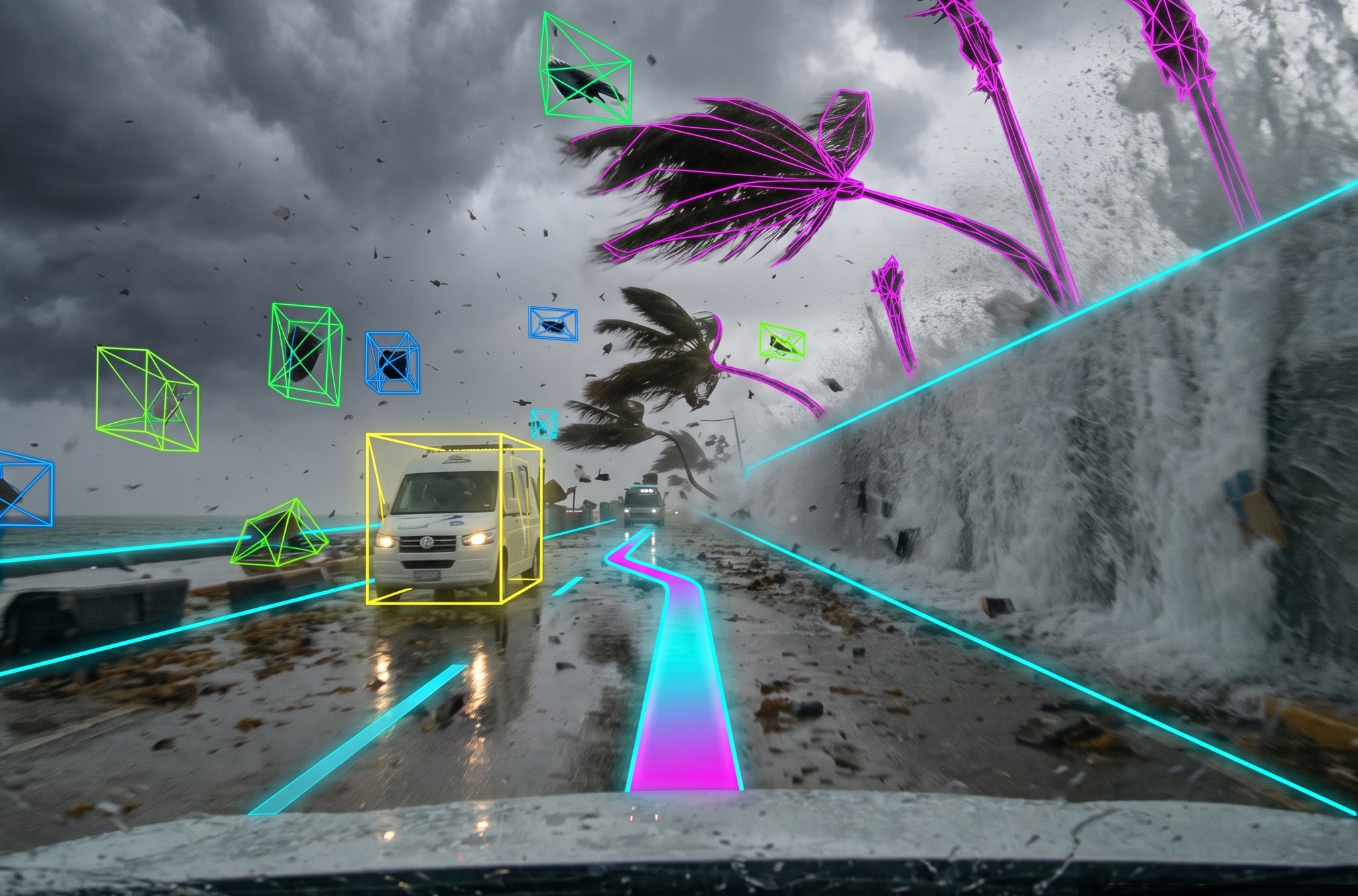
Back in January 2025, we wrote a blog about NVIDIA Cosmos and what it signaled for physical AI. The focus then was on world models - systems that could generate synthetic environments and sensor data needed to train machines to operate in the real world.
Synthetic data is still a cornerstone of physical AI. But a lot in the past 15 months. This blog will cover some of those changes by looking at NVIDIA’s new software stack for autonomy.
Why Simulation Matters
Before getting into what’s new, it’s worth revisiting why simulated data matters in the first place.
One of the persistent challenges in autonomy is edge cases. Most “real” driving data looks the same. Clear lanes, predictable traffic, normal weather. The situations that matter most are the ones that rarely happen. A pedestrian behaving unexpectedly. Debris on the road. Severe weather that disrupts visibility and traction. These scenarios are difficult to collect and use effectively.
That’s part of why simulation has become so important. It allows developers to recreate conditions that are too rare, dangerous, or expensive to capture in the real world. A hurricane scenario is a good example. It’s not something you can realistically collect at scale, but it’s exactly the kind of situation a system needs to handle.
Cosmos was built to address this gap. It expands the range of environments and conditions available for training. More variation, more coverage, more opportunities to expose models to the long tail of real-world behavior.
But generating more scenarios is only part of the story.
The Limits of Static Training Data
Here is the current pattern: show an AI model large amounts of data and it learns to recognize patterns within it. This is true with LLMs. It’s also true with models that generate synthetic views of the physical world. Until recently, this process was inherently one-directional (data > model).
But driving is inherently interactive. A small change in timing or positioning can lead to very different results. Static datasets don’t fully capture that dynamic.
From Simulation to Interaction
NVIDIAs new model, AlpaDream, introduces a different approach. It brings interaction into the training process.
Instead of relying on fixed scenarios, the model operates within a simulated environment. Its decisions influence what happens next. Those outcomes are fed back into training, creating a continuous loop between action and result.
This setup allows the model to explore variations of a scenario, encounter consequences, and adjust over time. The simulation becomes more than a data source. It becomes an environment for learning.
Simulation, Interaction, and Real-Time Decision Making
So far, this describes how synthetic environments are created. But NVIDIA has taken this a step further by launching Alpamayo, an open-source real-time reasoning model. It uses real or synthetic to produce real time data about steering, breaking, and trip planning. It’s the ‘brain” for autonomous vehicles, reasoning about the world it's driving through and making decisions in real time.
This combination creates a tight connection between perception, reasoning, and action. The model is not just learning what a situation looks like. It is learning how different decisions play out. The relationship is clearer in this context:
- Cosmos generates environments.
- AlpaDream turns those environments into interactive training grounds.
- Alpamayo reasons and operates within those environments.
Together, they move training from a static dataset toward something closer to a system that can iterate within its own simulated experience.
Why This Shift Matters
This shift addresses a core bottleneck in autonomy. Real-world data will always be limited in coverage, especially at the edges. Simulation helps fill that gap, but its value depends on how it’s used. When models can interact with simulated environments and incorporate the results of their decisions, the training process begins to capture more realistic behavior.
This is particularly important for safety-critical systems. Recognizing a scenario is not enough. The system also needs to respond appropriately when conditions change.
Beyond Autonomous Driving
Stepping back, this reflects a broader direction in physical AI. The combination of world models, closed-loop training, and reasoning models is starting to define how autonomous systems are developed. The same pattern is showing up across robotics, industrial automation, and other areas where machines operate in complex, changing environments.
Autonomous vehicles are the most visible example, but they are also one of the hardest markets to enter. Long timelines, heavy regulation, and high capital requirements make them less accessible at the earliest stages.
Other sectors are moving faster. Warehousing, construction, inspection, and field robotics all face their own versions of the edge case problem. These markets don’t require full autonomy on day one, but they still benefit from better simulation and training. That makes them more practical starting points for many companies.
What’s Changed Since Cosmos
When we first looked at Cosmos, the emphasis was on synthetic data at scale. The ability to generate more data than could be collected in the real world. What’s becoming clearer is that scale alone is not enough. The structure of training is evolving alongside it.
AlpaDream highlights that shift. Simulation is moving from a supporting role to a central one, where systems improve through interaction as well as observation.
That interaction feeds models like Alpamayo, which are responsible for making decisions in real time. Together, these layers form a tighter loop between simulation, training, and action. This has implications well beyond autonomous driving.
